


Abstract. This technical article examines John Browning’s design decisions regarding the geometry between the barrel (bore axis) and the grip in early semi-automatic pistols and compares four key models: the FN 1900, Colt 1903 “Pocket Hammerless,” Colt 1911, and (as a later development line) the FN High Power (Hi-Power). The focus is the expression of the grip/barrel angle and the consequential effects on recoil control, muzzle flip and point of aim.
Term and significance of the “barrel-to-grip angle”
The term “barrel-to-grip angle” used here describes the relational geometry between the longitudinal axis of the barrel (bore axis) / sight-line and the grip axis (through the palm/wrist axis). Technically relevant are two interlinked parameters: 1) the inclination (angle) of the grip relative to the bore line and 2) the height of the bore axis above the top of the grip (bore-axis height). Both influence the recoil-induced torque about the wrist pivot and thus the muzzle rise (muzzle flip), the repeatability of the point of impact and the ability to reacquire the sight picture during rapid fire.
In his designs Browning engaged early and systematically with how to combine mechanism, magazine position, firing pin/lockwork and ergonomics into a compact, reliable semi-automatic pistol. His variants show how the barrel/grip angle evolved in response to functional constraints (locking system, magazine location, trigger mechanism) and ergonomic findings.
Reference models
1899 – FN 1900 (Browning): One of the first successful semi-automatic pistols with compact design, magazine in the grip, early attempts to harmonize lock/slide geometry and grip geometry.
1903 – Colt 1903 “Pocket Hammerless” (Browning for Colt): Refinement for the civilian market — a slimmer, pocketable layout; ergonomically a steeper grip compared with some contemporary military pistols.
1911 – Colt 1911 (Browning): Full-caliber service pistol (.45) with a large frame; design with a low bore axis relative to the hand, while producing a pronounced recoil impulse because of caliber and mass.
ca.1930 – FN High Power (Hi-Power): A later development line, initiated by Browning and further developed by Dieudonné Saive at FN; combines high magazine capacity with a modern grip-angle balance.
The cited models serve as constructive reference points for the discussion of angle development.
Technical analysis of the reference models
FN 1900 — early integration of mechanism and ergonomics
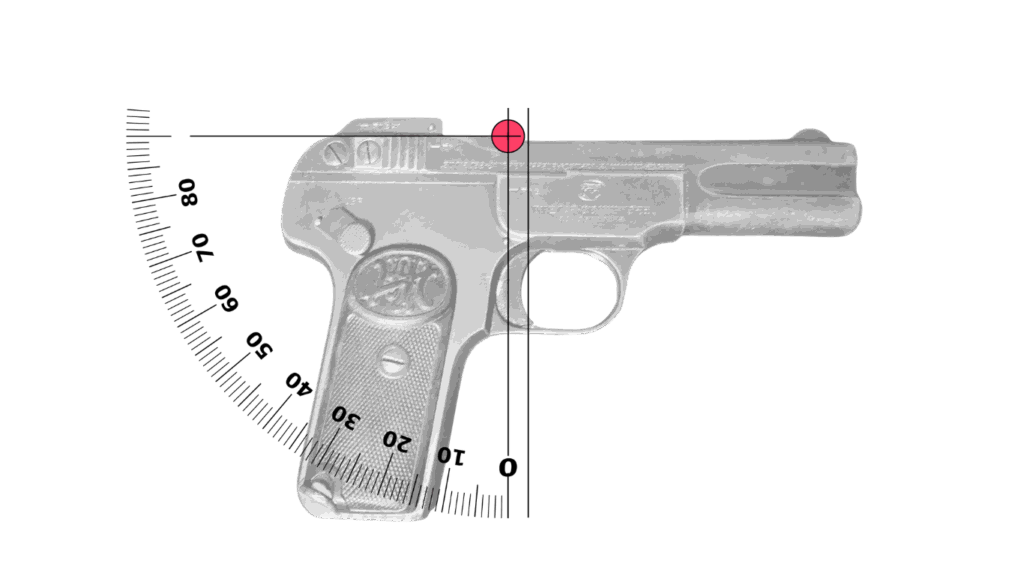
Structurally the FN 1900 aims for compact dimensions. The magazine-in-grip layout was already standard; the grip inclination is moderate in favor of a compact overall envelope. The bore axis sits relatively higher above the wrist than in later service-oriented pistols with a low bore axis. Consequence: with comparatively light cartridge loads a noticeable torque occurs — muzzle rise is more pronounced than in later low-bore designs. Grip angle approx. ~115–120°, a relatively steeper grip compared with service pistols.
Colt 1903 “Pocket Hammerless” — civilian ergonomic optimization
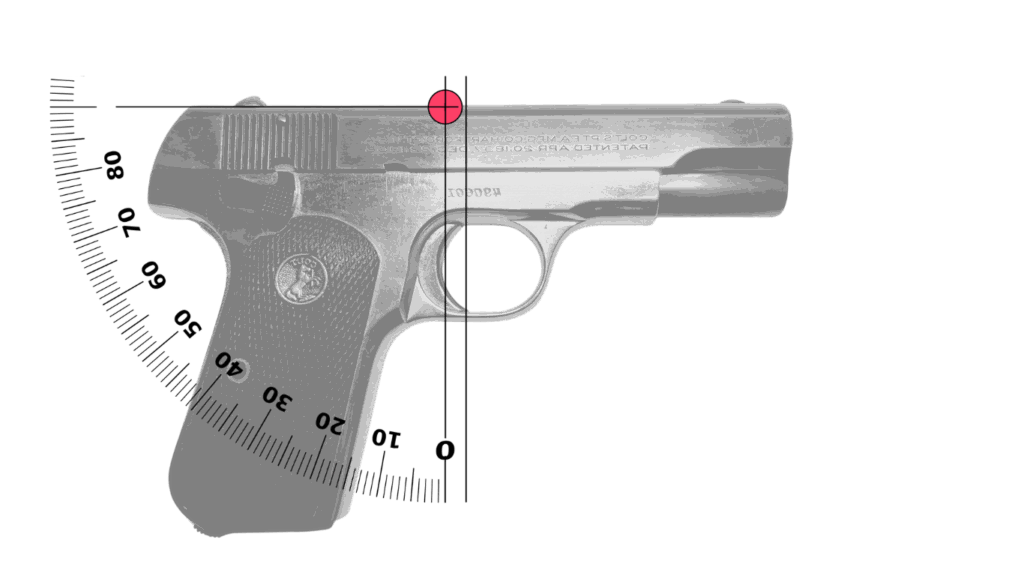
The Colt 1903 transfers Browning’s principles to the civilian segment: slim grip profile, grip axis set at a sharper angle relative to the barrel (relatively steeper compared to service pistols), to produce a compact pocket pistol. The combination yields handling optimized for quick access; at the same time the bore axis is not particularly low, so muzzle rise can still be felt with stronger loads. The construction priority was size/handiness rather than minimization of the lever arm. Grip angle: ~112–118°, steeper than service pistols.
Colt 1911 — service pistol with deliberately low bore axis
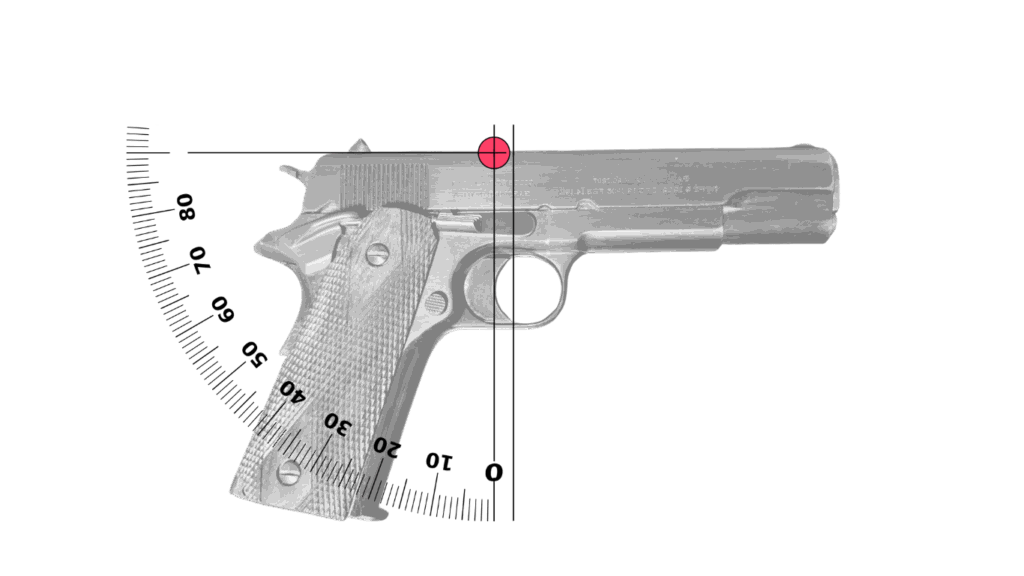
The Colt 1911 marks a milestone: Browning’s solution for a service pistol (.45) introduced substantial structural changes. The grip is designed so the bore axis lies relatively low above the wrist (lower bore axis compared with the previously mentioned pocket pistols). Effect: reduced rotational recoil moment, less muzzle flip, improved repeatability in rapid/series fire. The 1911 demonstrates how component mass, frame height and lever geometry are deliberately used for recoil control. Grip angle: ~108–110° (≈ 18° off-square / 18° “grip angle”) — an established value in the literature/technical discussions (the 1911 is classically cited with ~18° grip angle).
FN High Power — balance and capacity, evolutionary refinement
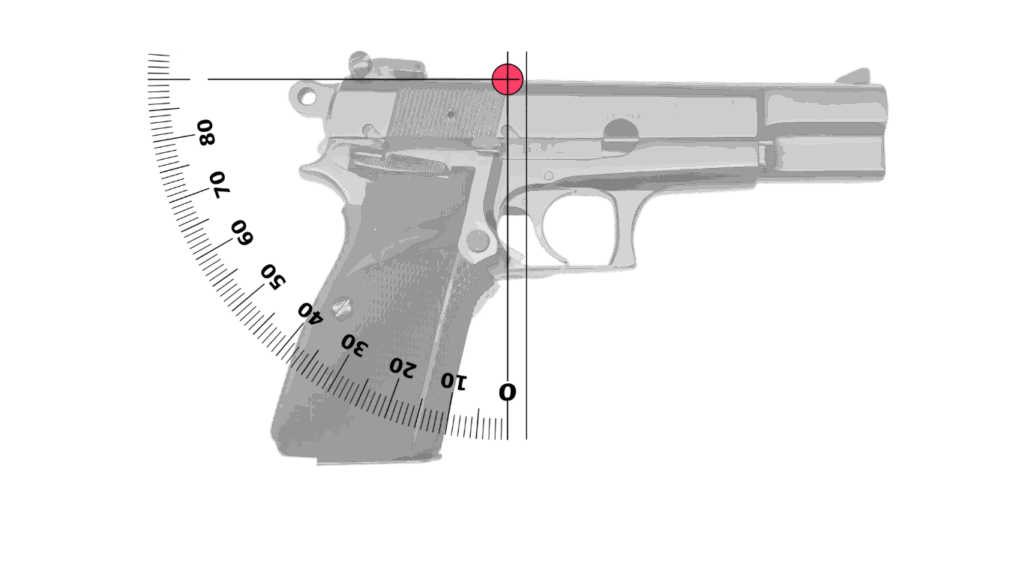
With the Hi-Power Browning/Saive applied accumulated experience: a moderate grip angle combined with a low bore axis and a slim grip profile to achieve high magazine capacity. Although the Hi-Power later became regarded as a “modern” service pistol, it does not exhibit an extremely flat grip angle but rather a balanced geometry that links recoil control and an ergonomic pointing attitude. Grip angle: ~105–108°; in technical comparisons and grip charts the Hi-Power is classified as having a flatter / more neutral grip angle compared with the 1911; many sources list Hi-Power angles in the ≈105–108° range.
Evolutionary line — from “high over the grip” to “low over the grip”
Early semi-automatics (FN 1900, Colt 1903): focus on compactness; bore axis tended to be higher above the grip; result: greater muzzle flip with higher loads.
Service pistols (Colt 1911): deliberate lowering of the bore axis and adjustment of the grip angle to reduce rotational moment; aim: improved controllability with larger calibers.
Later evolution (FN Hi-Power and successors): optimization between magazine capacity, ergonomic grip angle and low bore axis; the resulting geometry is a compromise that enables controlled rapid fire.
The driving design logic is: the heavier the cartridge and the higher the required rate of fire, the stronger the need for a low bore axis and a grip angle that optimizes the return of the fist toward the firing hand.
What values have proven “optimal”?
From the comparison and from numerous technical comparisons as well as practice-oriented test reports clear, recurring findings emerge:
Primary rule: as low a bore axis as possible (smaller lever arm) — produces a marked reduction in muzzle flip and faster sight-picture recovery. In modern service and competition pistols a bore-axis distance in the ≈8–16 mm range from the hand contact point is therefore considered favorable (the 1911/Hi-Power family lies at the lower end or slightly above).
Optimal grip angle ≈ 105–110° (backstrap ↔ sight line) — in practice a moderately flat grip angle (specified as backstrap-to-sight-line: approx. 105–110°, often corresponding to roughly 18° off-square in the 1911) has proven a useful ergonomic compromise between natural point-of-aim and recoil control. Manufacturers orient to this: 1911-style designs ≈110°, Hi-Power-style designs ≈105–108°.
Design constraints: magazine position, locking system and desired capacity force compromises in certain designs. Browning’s historical development demonstrates this: early pocket pistols (FN 1900, Colt 1903) could not achieve an extremely low bore axis due to compact geometry and spring arrangements; service models (1911, later Hi-Power) exploited these findings to produce more controllable service pistols.